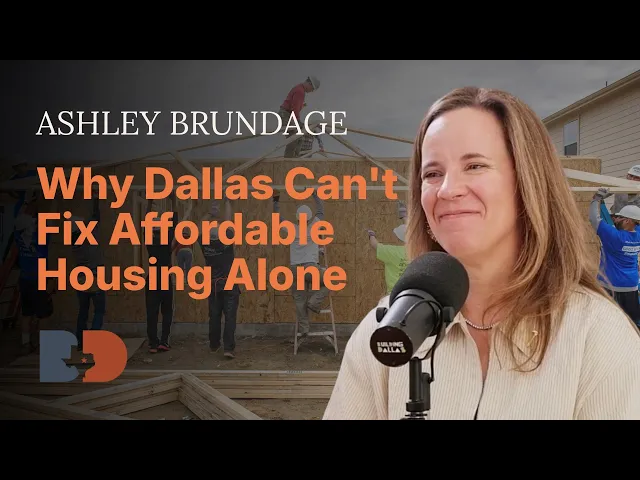
Building Dallas S2E5 – Ashley Brundage, Dallas Habitat
When Ashley Brundage became president and chief executive officer of Dallas Area Habitat for Humanity in May 2024, the affiliate was building fifteen homes a year. In the 1990s it had built close to a hundred. Two years into the job, she has a target of twenty-five a year, three neighborhood-scale developments in motion, and a blunt read on why the number fell in the first place: land in Dallas got expensive, the cheap-lot pipeline dried up, and Habitat kept trying to do all of it alone. In this episode she sits down with host Chris Arrington to walk through what it actually costs to put a family in a house they own.
"We need to become the answer to the affordable housing crisis in Dallas. We cannot wait on other people to do it."
A Coppell Kid, a Grandfather's Wood Shop, and a Son Headed to Trade School
Brundage grew up in Coppell, graduated from Texas A&M, came back to Dallas, and never left. She lives in Coppell again now with two teenagers, and the way she describes them tells you something about the household she came out of. Her seventeen-year-old is in the tech magnet program at Coppell High, deep into welding and automotive work, and headed for trade school rather than a four-year degree. Her fifteen-year-old just got into the sports medicine program.
Her own grandfather was an industrial education professor at Texas A&M — a professional shop teacher, as the family puts it — who built his own furniture in a backyard wood shop and once disassembled a brand-new car engine across the front lawn purely because, in his words, he needed to see how it worked. When her mother married her father, the grandfather took him under his wing and taught him to fix things. Chris Arrington's own family ran the same way, right down to a Ford 8N tractor that spent the entire 1970s in pieces on his mother's side of the two-car garage before it finally turned over. That shared background is why the conversation goes straight at the trades, and why Brundage's list of what Dallas is short of runs four items long: "We need welders. We need roofers. We need electricians. We need plumbers."
It is a familiar argument at a company that has spent 42 years roofing North Texas, is a family business itself, and is more or less permanently hiring for those same trades. Both of them are making the same point from opposite ends of it: the skills do not transmit on their own, and somebody has to be standing there teaching them.
How Thirty Volunteers Frame a House in a Single Day
What most people know Habitat for is the volunteer construction model, and Brundage's explanation of it is more industrial than the image suggests. It runs in two phases. Every studded wall in every house gets built in Habitat's wall shop, largely by volunteers. Two pallets of finished walls then move out to the lot, and on day one a crew of roughly thirty people stands the entire house up. "It actually looks like a house when they're done at the end of the day," Brundage says.
You can show up having never held a hammer. What makes that work is a layer of long-tenured core volunteers — some of whom have been with the Dallas affiliate for thirty and forty years, the entire span of its existence — who run the site and teach whoever walks on. Becoming one is a real credential: about forty hours through what Habitat calls Habitat University, part online and part hands-on, covering site safety and the specific way Habitat builds its four or five standard house designs. Core volunteers can then lead others. Beyond that is house leader, which means owning an entire build, staffing it with the right number of core volunteers, and splitting thirty people into the groups that side a wall, cut studs, or come together to set a truss. Summer build days start at 6:30 in the morning and wrap by 11:30, before the heat wins.
The people who come back are the ones Brundage says catch what her staff calls habititis.
"Once you get involved with Habitat, you don't wanna leave."
Roughly ninety percent of Dallas Habitat's inexperienced volunteers currently arrive through a corporate sponsor — a company that either funds an entire home and staffs eight to ten build days with its own employees, or buys a single day and sends twenty people. Brundage wants that ratio to change, and is candid that corporate demand is currently absorbing most of the slots a member of the public would otherwise take. The two nearer-term openings are becoming a core volunteer, which guarantees you a spot, and Habitat's two ReStores — one at Hampton and Singleton, one on Walnut Hill near Harry Hines — which resell donated and liquidated home goods to fund the mission and need help on the floor year-round. Those stores are also where the flooring, lighting, and furniture for a small renovation turn up cheap: high-end donated couches and beds, room-sized name-brand rugs for forty dollars, and the sample chandeliers left over from Dallas Market Hall's twice-yearly lighting show.
Not a Handout: The 0% Mortgage and Who Actually Qualifies
The misconception Brundage corrects fastest is the one about giveaways.
"A lot of people think we're giving away houses, and they have a mortgage just like anybody else."
Habitat homeowners buy their homes. What is unusual is the terms: zero percent interest, zero down payment, and a deed restriction that caps the annual property tax increase at two percent, which leaves insurance as effectively the only moving part in the payment. Getting there runs through a suite of financial education and mortgage-readiness coursework — credit, savings, what ownership actually costs — ending in a HUD certification that the buyer is mortgage ready. Eligibility sits around eighty percent of area median income or below, which in practice means a household of three or four earning roughly sixty thousand dollars or less. Bank employees and real estate brokers volunteer to teach those classes.
Homeowners are usually identified before construction starts, which means they build alongside the same core volunteers for the length of the project and tend to stay friends with them for years. Brundage's examples land nowhere near the young-family stereotype: a roughly eighty-year-old veteran exiting homelessness who bought his first home with his wife; a nineteen-year-old whose Joppa key ceremony drew other Habitat homeowners from the same street to come welcome her; a DISD teacher and her daughter Jordan who had been doubled up with grandma and moved into a two-bedroom, two-story house of their own. Most of Habitat's buyers, she says, are women heading their own households, largely single mothers — which is why the affiliate runs a Women's Build Initiative every year.
The teacher is the case she keeps returning to, because it stops being a housing story and starts being an economics one. "Our teachers can't even afford to live in the city anymore," she says. "And that's gonna hurt us." A city that prices out the people who staff it, in her framing, is not facing a charity problem but an economic development one.
Fifteen Homes to Twenty-Five, and Why Habitat Stopped Building Alone
Getting back to twenty-five volunteer-built homes a year is the floor, not the ambition. Twenty-five is roughly where the math breaks even across the affiliates Dallas benchmarked itself against. The growth beyond that comes from a change in posture: Habitat has stopped trying to be a land developer. "While Habitat is really good at doing home construction," Brundage says, "when it comes to developing land and building roads and putting in lights, that is not our expertise."
So it partners. The first project to come online is twelve townhomes dropped into the middle of the parking lot at Wheatland Plaza in Duncanville, a U-shaped strip center revitalized by Monte Anderson, a small-scale developer who calls himself an incremental developer. The second, targeted for late 2027, is Mill City in South Dallas near Fair Park: twenty-four townhomes built with Matthews Southwest and the neighborhood violence-interruption nonprofit Urban Specialists, after Habitat and Matthews realized they held large adjacent parcels and would do better combining them than each building alone. The economics are legible on both sides — Matthews earns a developer's fee below its commercial rate, Habitat brings the nonprofit funding streams that create the affordability, and Habitat recovers its money when the townhomes sell.
Density is the point. Dallas has stopped producing starter homes, and the older stock that used to serve that role is being torn down and replaced with large houses.
"Our starter home is disappearing."
Attached townhomes structured as a condo association still build equity, which is what lets a first-time buyer move up and out later. The same product serves seniors whose fixed incomes can no longer carry an apartment but who want to age in place in the city they grew old in. And the third leg, which Brundage says Dallas Habitat let slip for years, is advocacy — using the platform Habitat's international brand hands it to argue for policy at the city level, because twenty-four townhomes at a time will never reach the scale the policy changes could.
One Roof in Joppa: Where Habitat Stops and Arrington Starts
Habitat's largest current commitment is Joppa, the oldest freedmen's town in North Texas, settled by freed slaves and now backing onto the Trinity River and the Trinity Forest — beautiful, largely unknown, and sitting directly across from a concrete batch plant whose dust the community has been fighting for years. Habitat has worked there for two decades and put up more than 150 homes.
October 19th through 24th, the affiliate's 40th anniversary Rock the Block lands there: a full week with roughly 800 public volunteer slots, culminating Saturday the 24th in a block party with a DJ, food, a health and social services fair, a home dedication, and the volunteer awards Habitat usually stages as its own event. Twenty Habitat homes on Joppa Circle are getting repainted for free — after twenty years, Brundage notes, the Texas sun has had its way with them, which is roughly the same twenty-year mark at which a Dallas roof starts asking for attention. Volunteers will paint, landscape, reset buried paving stones, build ramps, and haul off abandoned tires. Every project on the list was requested by the neighbor who lives there.
The tone is deliberate. "We are not gala people," Brundage says. "We don't need tuxedos." Shorts and a T-shirt is the dress code for a 40th anniversary.
One job on that list is not going to volunteers. A Joppa homeowner runs an in-home childcare business out of a house with roof leaks bad enough to threaten it, and that house needs a major roof repair — which is where Arrington Roofing joins the week. Brundage is direct about why Habitat draws that line, and it is the cleanest articulation of the trade's value anyone has offered on this show:
"We are not shingling. We're not having any volunteers get up on a roof. That's just too risky for us, and it's such a professional job that needs to be done that we're grateful for y'all's help there."
It is worth sitting with what that means coming from an organization built entirely on the premise that untrained people can build a house. Habitat will hand a first-time volunteer a nail gun and a powder-actuated tool and have them stand up an exterior wall by lunch. It will not put that person on a roof. Shingle work is where the learning curve stops being forgiving — where the consequences of getting it wrong arrive as water, months later, in a room nobody was watching. That is the entire case for documented certifications and for knowing how to tell a real contractor from a convincing one, made better by a guest who has no stake in roofing than any roofing company could make it about itself. The proof, in both trades, shows up the same way: not in the brochure, but in what its own customers say afterward.
Brundage's closing argument is not really about houses. The hardest obstacle to building affordable housing in Dallas, she says, is the neighbors of the place it is going — people working from decades-old assumptions. "People have outdated perceptions of what affordable housing looks like and who lives in it," she says — myths and stereotypes that harden into the opposition an elected official hears from, and often the only thing that official hears at all.
Her fix for that is not a campaign. It is the wall shop. Get someone on a build site for one morning, let them stand a house up and meet the family buying it, and they will go argue with their own neighbors on your behalf — which is the political will that lets an elected official act. There is no silver bullet, she says repeatedly, and she means it as a description rather than an excuse. What is left, once the policy and the land costs and the zoning fight are all set aside, is much simpler.
"We're just trying to get someone in a home."
Ashley Brundage: dallasareahabitat.org
Building Dallas is a weekly conversation series about the people and businesses shaping North Texas, produced by Arrington Media and hosted by Arrington Roofing.