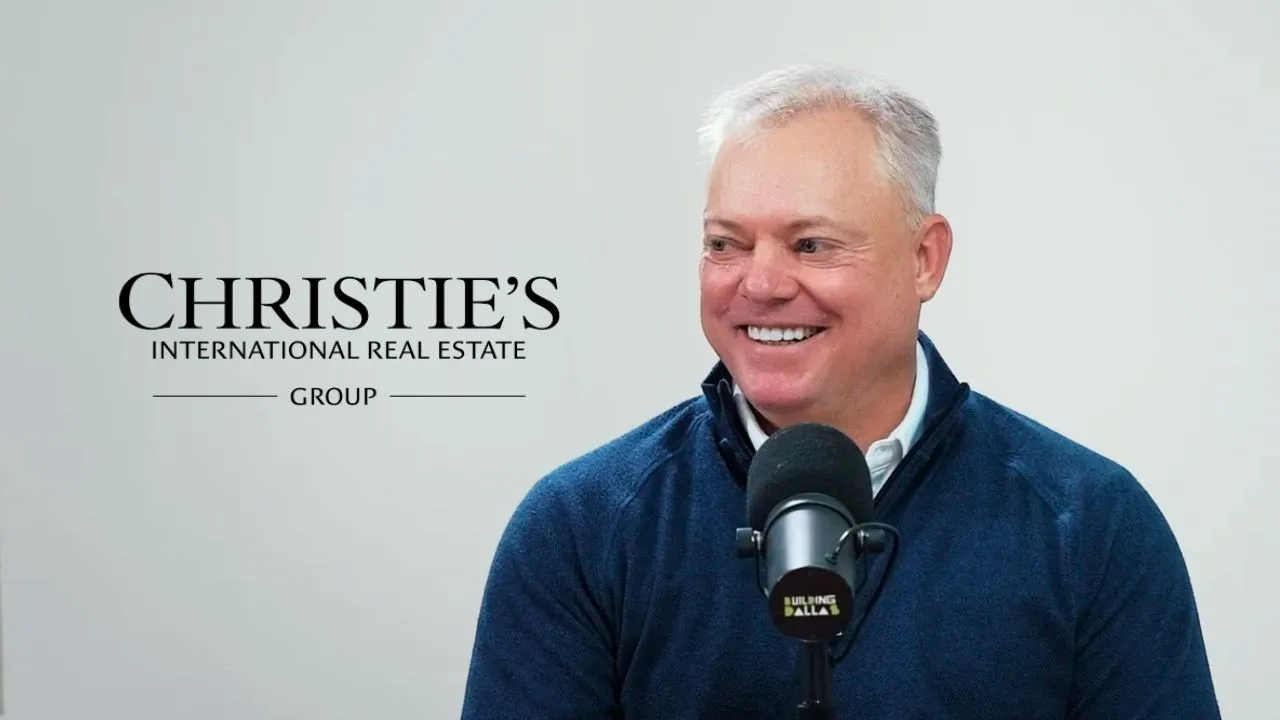
Building Dallas S2E3 – Jason Nemes, Summit Roofing
Jason Nemes drove himself to a clinic and died on the table before he ever swung a hammer for a living. In this episode, the founder and CEO of Summit Solutions Roofing and Construction — a two-time heart attack survivor, bestselling author, and TEDx speaker known online as The Tatted Prez — sits down with host Reese Arrington to trace a path from network marketing to sobriety to a roofing company that's on pace for eight figures this year — and to compare notes on what it actually takes to build a home-service brand people trust in a trade almost anyone can legally enter.
"The day I drove myself to the clinic and died on the table — that would've been the moment that changed everything for me. But it wasn't."
I Died on the Table, and It Still Wasn't the Turning Point
Nemes' actual turning point took two more years and a beach in Costa Rica. His first heart attack landed on Easter Sunday, April 4, 2021 — the kind of date that should rewrite a life on the spot. Instead, a couple of months later he used again at his own birthday party, told himself it would be a one-time thing, and couldn't stop. A week after that, alone and fading on a bachelor-party trip, he walked into the ocean and prayed.
"God, I don't know what's happening right now, but if you make this go away, I'll never touch this stuff again."
He says he felt clear within minutes and hasn't used since. He's almost five years sober now, a stretch he holds against the loss of his younger brother to a heroin overdose at 28 — Nemes was 34 at the time. He's candid that he still misses parts of that old life in certain rooms, with certain music, and that the honesty of naming that is part of what keeps him out of it. What replaced the high, by his own account, is winning itself — he's described impact and winning as a rush more powerful than any drug ever was, and it's the same intensity that now drives how hard he pushes Summit.
From a Trash Bag of Clothes to a Nine-Figure Goal
Before any of this, Nemes started 2013 with a trash bag of clothes and a spot on a friend's living room floor, digging through couch cushions for change to afford a five-dollar pizza. Network marketing came first — not roofing — and he built it into a team of roughly 4,500 people worldwide and a multi-seven-figure residual income at its peak, income he says still pays him six figures a year today. When that company took a direction he didn't want to follow, a friend's call about starting a roofing business landed at the right moment. He didn't start from zero on day one, either — years before Summit existed, he'd already built a following online as The Tatted Prez, and that audience gave the new company a head start most first-year roofers never get.
Summit Solutions Roofing and Construction isn't even two years old yet, and it's already grown fast enough to plan an expansion into six states, including Florida and Maryland. Nemes' stated goal is a nine-figure company within three to five years; his target for this year alone is eight figures. He credits the leadership and culture-building skills from his network-marketing years, not any roofing background, as the actual engine behind that speed.
Two Companies, One Standard for Earning Trust in Roofing
Nemes and Arrington spend a good part of the conversation comparing notes between a company not yet two years old and one with 42 years — and they arrive at the same conclusion from opposite ends of the business: credentials and follow-through are what actually earn a homeowner's confidence in a trade almost anyone can enter overnight.
"There's no barrier to entry to get into roofing in Texas, so anybody can do it. I've dealt with other roofers who were siding companies the year before, and they jump into roofing with none of the credentials."
That's exactly the gap storm season exploits every year in North Texas — crews with no track record and no reason to still be answering the phone once a check clears, a dynamic Arrington has written about directly in its own piece on why Texas doesn't require a roofing license, and what that means for homeowners. Arrington leans on decades of tenure and manufacturer paperwork to stand apart from that wave, and Nemes has built his own version of that discipline as Summit scales, an increasingly selective bar for who's allowed to represent the Summit name in the field, the kind of quality control most young companies don't adopt until years after Nemes built it in from day one. Both businesses are also thinking about longevity in parallel: Arrington's next generation is now running day-to-day decisions his father once made without formal process, and Nemes rehires former employees only when the reason they left, and the reason they want back, both hold up.
Reese carries that same standard into ethics rather than paperwork: his rule is that a homeowner with a few scattered hail hits that wouldn't come close to covering a $10,000–$35,000 deductible shouldn't be talked into filing a claim at all, even when the sale would be easier if he did — a stance Arrington backs up in its own breakdown of how ACV, RCV, and deductibles actually work. Nemes built that same credibility through persona rather than paperwork: before Summit had its first five-star review, he already had a bestselling book and a TEDx talk behind him — pulled from the same heart attack story that opens this episode — plus over a decade of leadership credibility built during his network-marketing years. That credibility turned directly into margin once suppliers started competing for Summit's business instead of the other way around, the same logic behind Arrington's own guide to choosing a roofing contractor in Dallas: the credentials matter because the shingles themselves don't tell a homeowner anything.
Warranties, Materials, and Why the Manufacturer Matters More Than the Installer
Reese frames the whole warranty conversation around one line: you're not just selling a roof, you're selling and standing behind a product that has to actually perform for decades after the crew leaves. Both companies lean on manufacturer-backed guarantees precisely because the trade itself carries no license requirement — Summit is a TAMKO Diamond contractor, and Nemes' pitch to a hesitant homeowner is straightforward: regardless of whether his company is still standing in ten years, TAMKO's own workmanship warranty holds either way. Reese walks through the identical mechanics from Arrington's side: a manufacturer-backed, non-prorated warranty survives even if the installer doesn't, which is the entire point of certifying with a manufacturer rather than just buying materials off a shelf.
Reese also walks through F-Wave, a newer synthetic shingle rated for a 50-year lifespan against a standard asphalt shingle's 20, and does the rough math: factoring in insurance discounts, F-Wave can work out to roughly a fifth of the cost of replacing asphalt shingles repeatedly over that same half-century, even though the material's long-term track record isn't fully proven yet. Arrington lays out that same math in more detail in its own piece on why a 50-year synthetic roof pays you back — the theory being that a homeowner who replaces an asphalt roof three or four times over that span usually ends up spending more than someone who paid for durability once. On the claims side, both companies point customers toward a financing page rather than a discount when a deductible needs covering, and reserve hail damage repair claims for damage that actually clears that bar.
The Secret Sauce: Motivating a Team to Win
Later in the conversation, Nemes shifts from strategy to what he calls his secret sauce for actually motivating a team — and it isn't a comp plan. By his own account, watching someone else on his team close a deal gives him nearly the same charge as closing one himself, and he frames his job less as managing people and more as equipping them to succeed.
"My goal is to equip you to succeed."
That philosophy runs straight into the numbers he actually tracks: across a recent five-week stretch, Summit logged around 87 signed contingencies against roughly $2.25 million in business, and Nemes treats recruiting as constant rather than seasonal — he looks for candidates with at least some prior sales experience and keeps hiring even when the pipeline looks full. Arrington runs an identical playbook on its own roofing sales representative opening, for the reason both companies keep circling back to: a home-service company's growth ceiling is usually a sales-team-size problem long before it's a demand problem.
Success, AI, and What Actually Wins Long-Term
Reviews come up too — Summit sits at 4.9 stars on roughly 75 five-star reviews against a single one-star, and Nemes argues an imperfect record reads as more credible than a suspiciously perfect one, a point he backs with the same logic Arrington applies to its own testimonials page. On where technology is headed, Nemes is building toward an app that generates a roofing estimate in five to ten seconds, and he's skeptical that robots replace skilled roof labor anytime soon — the pitch variation across a single roof is still, in his view, beyond what a robot handles economically, and cheap Texas labor makes automation an even harder sell here specifically.
He's just as direct that a college degree bought him nothing his own hustle didn't teach faster, and that money itself isn't the corrupting force people assume — it simply reveals whatever was already there.
"Money just magnifies you of who you actually are. It will expose your true heart and who you are as a person."
He closes on the same note that opened the episode: persistence, not talent or timing, is what actually compounds.
"The universe can't deny somebody who gets up every single day and gives it their absolute all."
Jason Nemes: roofsbysummit.com
Building Dallas is a weekly conversation series about the people and businesses shaping North Texas, produced by Arrington Media and hosted by Arrington Roofing.