Before the First Freeze: The Dallas Roof Checklist Nobody Does in October
By Reese Arrington, Arrington Roofing - Published September 2026
Roofing in Dallas runs on a spring clock. Hail arrives, phones ring, adjusters get busy, and by July most of the metroplex has stopped thinking about the roof entirely. Then the first freeze lands in late November, something that had been quietly wrong all autumn finally gives, and a repair that would have cost a few hundred dollars in October becomes a ceiling stain in December.
October is the cheapest month of the year to find a roof problem in North Texas. The weather is mild enough to work in, the storm-chasers have left town, and nothing is urgent yet, which means you get an honest look rather than a rushed one. This is the list we would want a Dallas homeowner to work through now. If you would rather have someone else do it, Arrington provides a free, no-obligation inspection and a written report, and you can request one here or call (214) 698-8443. We have been on Dallas roofs since 1983 and there is no pressure attached to the visit.
Why October and Not December
Two reasons, and both are about temperature rather than the calendar.
The first is that roofing materials move. Asphalt shingles, metal flashing, sealant and the wood deck underneath them all expand and contract at different rates, and North Texas asks a lot of them. A Dallas October can swing thirty degrees between afternoon and dawn, and once winter arrives the swings get sharper. Sealant that has gone chalky and hard will hold through a mild autumn and split the first time it is asked to flex in a freeze. You can see that sealant clearly in October. You cannot see it at all once water is already coming through.
The second is that repairs are easier to schedule and easier to do well. Sealants and adhesives have minimum application temperatures, shingles are more brittle when cold and more likely to crack when walked on, and roofing crews across the metroplex are quieter in autumn than they are in May. A repair booked in October gets done properly and on your timetable. The same repair booked after a freeze competes with everyone else who waited.
What February 2021 Actually Exposed
Most Dallas homeowners remember the February 2021 freeze for the power grid and the burst pipes. Roofers remember it differently, because it worked like a stress test on every weak point that had been tolerated for years.
Very little failed because of the cold on its own. What failed was the combination: prolonged sub-freezing temperatures on roofs that were already carrying a small defect, plus attics that could not shed moisture, plus gutters and valleys that could not drain when the thaw finally came. Flashing with tired sealant let water in. Attics that could not exchange air held humidity against the underside of the deck. Gutters still full of autumn debris held standing water that froze, and meltwater backed up under the first courses of shingle instead of running off.
It is worth being precise about that last one, because roofing advice written for colder states does not transfer cleanly here. Dallas does not normally get true ice dams, which need lying snow and heat escaping through the roof to form. What North Texas gets is repeated freeze-and-thaw on water that had nowhere to go, which damages the same places for a different reason. February 2021 was the rare year when both happened at once. In an ordinary Dallas winter, drainage is the thing to get right.
None of those were new problems in February. All of them were visible the previous October. That is the whole argument for doing this now.
The Checklist
Work through these in order. Most of it happens from the ground, a ladder at the eaves, or inside your attic, and none of it requires you to walk the roof.
1. Look hard at every piece of flashing
Flashing is the metal that seals the joints where the roof meets something else: chimneys, walls, skylights, vent pipes, valleys. It is where the large majority of roof leaks actually start, not out in the open field of shingles, and that is true of every roof covering there is.
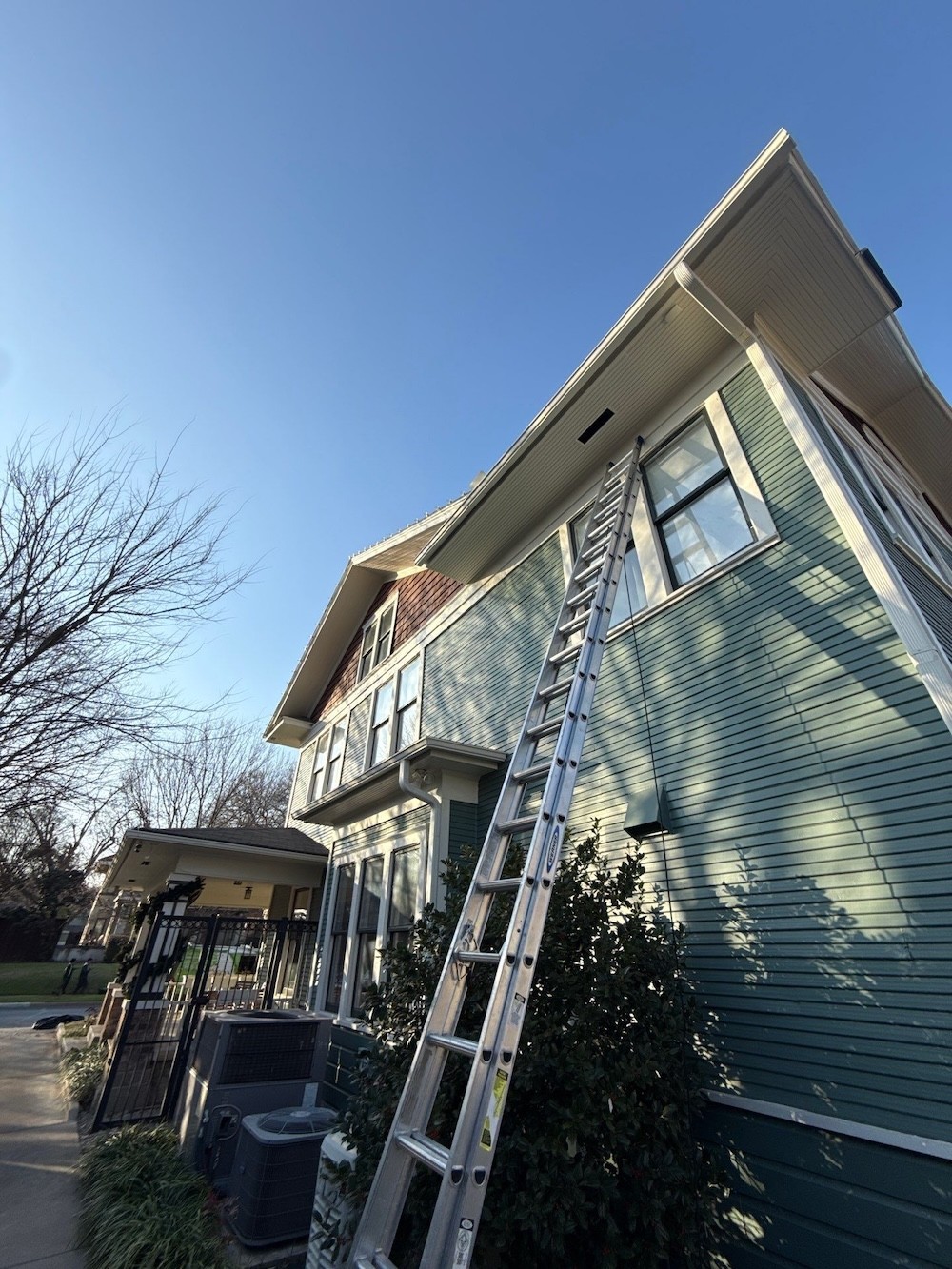
From the ground with binoculars, or from a ladder at the eave, look for metal that has lifted away from the surface it is sealed against, sealant that has cracked, shrunk back or turned chalky and grey, and rust or staining running down from a joint. Around the chimney specifically, look at the counter-flashing where it tucks into the mortar. If you can see a dark line of gap, that joint is open. Sealant is the shortest-lived component on your roof and it is the cheapest thing on this list to renew.
2. Clear the gutters, then check they actually drain
Clearing gutters is the obvious half. The half people skip is testing them. Run a hose into the highest point and watch what happens. Water should move visibly and leave through the downspout within seconds. If it pools, backs up at a seam, or sheets over the front edge, the gutter is either blocked further along, pitched wrong, or pulling away from the fascia.
This matters more in a freeze than it does in a storm. A gutter that drains slowly in November holds standing water in December, and standing water that freezes and thaws repeatedly is heavy enough to pull a gutter off its fasteners. It also pushes meltwater backwards under the shingle edge rather than away from the house. Autumn debris is the usual culprit, and we wrote about where it comes from in the enemies of your roof in Dallas.
3. Get into the attic with a torch, before it gets cold
This is the single most useful twenty minutes on the list and almost nobody does it. Go up on a bright day and turn your torch off for a moment once your eyes adjust. Daylight visible through the roof deck means a hole. Then look for dark staining on the underside of the decking or along the rafters, any rusted nail tips, and damp or compressed insulation.
What you check next depends on which kind of attic you have, and this is where a lot of roofing advice goes wrong for newer Dallas homes.
If you have a traditional vented attic, which covers most Dallas housing stock built before roughly 2010, look at the soffit vents at the edges of the attic floor and at the ridge vent or static vents above. Blown insulation very commonly drifts over soffit vents and blocks them completely, which stops the whole system working. Ventilation here is not a comfort question, it is a roof-life question: an attic that cannot exchange air holds the moisture your household produces against the cold underside of the deck, and that condensation does the same damage a slow leak does. The code benchmark is one square foot of net free ventilating area per 150 square feet of attic floor, or one to 300 where intake and exhaust are properly balanced. Our attic ventilation page explains how that balance works and why it matters for your roof's health.
If you have a sealed or foam-encapsulated attic, which is increasingly common in DFW homes built in the last fifteen years, ignore everything in the paragraph above. There are no soffit vents to check and the ventilation ratios do not apply, because the insulation sits against the roofline and the attic is intentionally part of the conditioned space. What you check instead is the interface between the foam and the deck: any staining, any smell of damp, any area where the foam has pulled away. You cannot see the decking through closed-cell foam, which is precisely the difficulty, so signs of moisture matter more here than they do in a vented attic where you can simply look.
There is a second issue worth knowing about if your home has one, and it is a warranty issue rather than a weather issue. Most asphalt shingle manufacturers void their warranties when shingles are installed over an unvented foam assembly without a ventilation gap. If your attic was foamed after the roof went on, which is common when a homeowner retrofits for energy efficiency, the roof warranty may no longer be what you think it is. We set out the detail in the risks of foam encapsulated attics in Dallas homes, and it is worth checking before winter rather than after a claim.
One thing not to worry about: if the underside of your roof deck looks like aluminium foil, that is radiant barrier sheathing, which is close to standard in new North Texas construction and is doing its job. It is not moisture and it is not a defect. We cover what it does in radiant barriers for Dallas homes.
4. Check the drip edge and the first three feet of roof
The lower edge of the roof takes the worst of a freeze-and-thaw cycle because it is the coldest part of the roof plane and it is where water has to leave. Look at the drip edge, the metal strip along the eave that directs water into the gutter rather than behind it. It should be continuous, fastened flat, and sitting over the gutter, not behind it or short of it.
A note on age here. Drip edge only became a code requirement for asphalt shingle roofs with the 2012 International Residential Code, so a newer Dallas home will almost certainly have it and plenty of older ones simply do not. If yours does not, that is not an emergency and it is not usually worth retrofitting on its own; it is something to specify when the roof is eventually replaced.
Then look at the shingles in the first few feet above it for lifted tabs, granule loss that shows as dark patches, or any course that sits proud of the ones around it. If your home has a north-facing slope, check that one first. It gets the least winter sun and stays frozen longest. Granule loss applies to asphalt only; if you have a synthetic or composite roof there are no granules to lose, and you are looking for cracking or impact marks instead.
5. Walk the perimeter and look up properly
Circle the house once, slowly, and look at the roof plane rather than at the house. You are looking for lines that should be straight and are not: a ridge with a dip in it, a valley that has gone shallow, a plane that waves rather than sits flat. Those suggest something structural or a deck that has softened, and they are worth a professional look regardless of season.
At the same time, note any branch now overhanging the roof. Live oaks and pecans across East Dallas put on a season's growth since you last looked, and a limb that clears the roof in still air does not clear it in a north wind.
6. Deal with the thing you already know about
Most homeowners already have one item on the mental list: the stain that appeared last spring and stopped, the shingle that came off in a storm and was never replaced, the skylight that wept once. A freeze is very good at finding those. If a leak seemed to fix itself, it almost certainly did not; it just stopped being visible, which is a different thing, and we explain why in why a roof leak feels sudden.
If Your Roof Is Not Asphalt Shingle
Most of the checklist above applies to any roof, because flashing, drainage and attic moisture behave the same way whatever the covering is. A few items do not, and if you have a metal, synthetic, tile or low-slope roof, these are the autumn checks that matter for your system specifically.
Metal
Metal moves more than any other roof covering, which is the whole point of how standing seam is designed to work: the panels are meant to expand and contract along concealed clips. What you are checking in autumn is whether anything is preventing that. Look at the sealant at penetrations and at the ridge and eave closures, and on an exposed-fastener system, look for screws that have backed out or whose rubber washers have hardened and cracked. Fastener washers are the usual failure point on that style of roof and they are cheap to replace before a freeze rather than after one.
Synthetic and composite
Synthetic shingles and shakes are far more forgiving in a freeze than asphalt, which is much of why we install so many of them in North Texas. They do not lose granules and they do not go brittle the way an ageing asphalt shingle does, so the granule-loss and cracked-tab checks simply do not apply. Your autumn check is the fastening and the flashing, not the field of the roof.
Tile
On a tile roof the tiles are the weather layer, but the underlayment is what actually keeps water out. Freeze-and-thaw finds hairline cracks in individual tiles, and a cracked tile is not urgent in itself, though it does expose the underlayment to sunlight and wear. Look from the ground for broken, slipped or missing tiles, and never walk a tile roof: you will break more than you find.
Low-slope and flat residential sections
If part of your home has a flat or low-slope section, and plenty of Dallas homes do over a porch, addition or garage, drainage is the only thing that matters before winter. Standing water that would simply evaporate in August sits and freezes in January, and the freeze-and-thaw cycle at a seam is how low-slope roofs fail. Check that scuppers and drains are clear and that water is not ponding a day after rain.
A note if you have solar
You cannot inspect the roof under a solar array, and you should not try. What you can do is look at the perimeter of the array and at the mounting penetrations you can see, and check the attic underneath that section particularly carefully for staining. If anything needs doing under the panels, the array has to come off and back on, which means your solar installer and your roofer need to talk to each other. That conversation is much easier in October than in an emergency.
What You Should Not Do Yourself
Everything above can be done from the ground, a ladder at the eaves, or inside the attic. We would not encourage you to go further than that.
Do not walk the roof to inspect it. Autumn shingles are cooler and more brittle than summer ones, morning dew on a Dallas roof is genuinely slick, and the damage caused by walking a roof badly is a real category of repair we see every year. Anything above a 6:12 pitch is fall-arrest territory for professionals and is not a homeowner job in any season. Do not attempt flashing or sealant work at height, and do not pressure-wash shingles, which strips the granules that protect them.
What Is Worth Doing Now and What Can Wait
Not everything on the list is urgent, and we would rather tell you that plainly than sell you a full replacement in October.
Do it now: anything involving flashing or sealant, gutter clearing and drainage, clearing blocked soffit vents, replacing missing or lifted shingles, and trimming overhanging limbs. These are all small, cheap while the weather is mild, and all of them get considerably more expensive after water has been through.
It can wait until spring: full replacement on a roof that is simply ageing but sound, cosmetic granule loss with no exposed mat, and material upgrades. If the roof will get through winter, there is no advantage in rushing the decision, and spring gives you a better range of scheduling and material choices. We walk through the repair-versus-replace judgement in tired of patching.
Then put the spring maintenance checklist in the calendar for March, before hail season starts again. The two lists together cover the year.
If You Find Something
If your walk-round turned up cracked flashing, a gutter that will not drain, daylight in the attic, or a stain you cannot explain, get it looked at while it is still small. A roof repair booked in autumn is a scheduled appointment. The same problem in January is an emergency, and emergency work is always more disruptive and more expensive than planned work, whoever does it.
Arrington's inspection is free and comes with a written report and photographs of whatever we find, so you have something to act on rather than an opinion. If the honest answer is that your roof is fine and needs nothing, that is what the report will say. Book an inspection or call (214) 698-8443, and we will get you on the calendar before the weather turns.