Do FORTIFIED Roofs Hold Up to Dallas Hail — and Do They Lower Your Insurance?
If you're weighing a new roof in Dallas, you've probably run into two ideas that sound related but aren't: a "FORTIFIED" roof and a "Class 4" impact-resistant shingle. FORTIFIED started in hurricane country, so the fair question in a hail market like ours is whether it does anything for the storms we actually get — and whether either choice will lower your homeowner's insurance. The short version: they solve different problems, they qualify for two different insurance credits, and neither discount is automatic.
Here's how they compare, what the FORTIFIED standard actually requires for hail, and what a Dallas homeowner should know before signing anything. For the full picture of what a FORTIFIED roof is and how it's built, see our FORTIFIED roof page — this article focuses on the hail-and-insurance questions that page doesn't dig into.
Does a FORTIFIED Roof Actually Protect Against Hail?
Not on its own. A standard FORTIFIED Roof is engineered mainly to resist high wind and to keep water out of the house if the roof covering is damaged — not to make shingles hail-proof. In a Dallas hailstorm its biggest benefit is the sealed roof deck: if hail or wind tears the shingles off, that secondary water barrier helps keep water from pouring into your home.
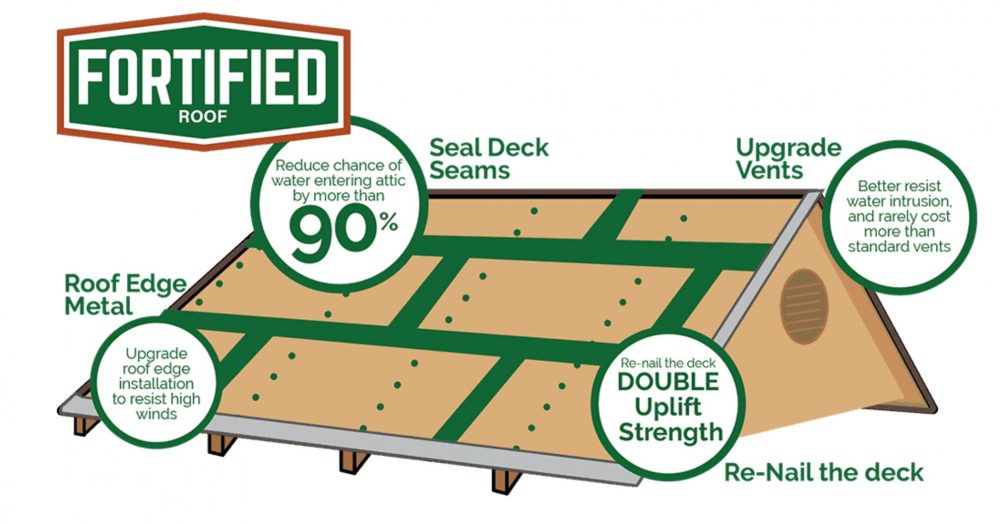
Hail impact resistance is a separate, optional add-on. FORTIFIED calls it the Hail Supplement, and it's the piece that actually addresses whether your shingles crack, bruise, or lose granules when the ice comes down. So a base FORTIFIED Roof plus the Hail Supplement is what fits a hail market best — the wind and water protection of the standard, plus a shingle built to take an impact.
What Is the FORTIFIED Hail Supplement?
The Hail Supplement is an optional upgrade to a FORTIFIED designation for homes in hail-prone areas. To earn it on an asphalt-shingle roof, the shingle has to score "Good" or "Excellent" on the IBHS Impact-Resistant Shingle Performance Ratings — a hail test the Insurance Institute for Business & Home Safety (IBHS) developed using manufactured hailstones that behave like the real thing, shattering and slushing rather than just bouncing.
This is the detail most people miss: the FORTIFIED Hail Supplement is stricter than the old rule of thumb. Under the current standard, effective November 1, 2025, it is no longer enough for a shingle to carry a UL 2218 Class 4 label — IBHS found many Class 4 shingles don't hold up as expected in realistic testing. The shingle has to earn a "Good" or "Excellent" score on the IBHS rating specifically. Not every Class 4 product qualifies, so the shingle selection matters.
FORTIFIED vs. Class 4 Impact-Resistant Shingles — What's the Difference?
Class 4 describes a shingle; FORTIFIED describes a roof system. A Class 4 rating (from the UL 2218 test) tells you a single product resisted a steel ball dropped from a set height. FORTIFIED tells you the whole roof — deck fastening, a sealed deck, reinforced edges, and the covering — was built to a documented standard and independently verified. You can put a Class 4 shingle on an ordinary roof, and a FORTIFIED roof can add the Hail Supplement using an IBHS-rated shingle. They're complementary, not interchangeable.
Roof type | What it upgrades | Hail impact | Wind & water intrusion | Insurance angle | Independently verified? |
|---|---|---|---|---|---|
Standard roof | Meets code | Standard | Standard | None specific | No |
Class 4 shingle roof | The shingle only | Improved (UL 2218 Class 4) | Standard | Impact-resistant roofing credit | No |
FORTIFIED Roof | The whole roof system | Standard | Strengthened | Wind-mitigation credit | Yes |
FORTIFIED Roof + Hail Supplement | System + IBHS-rated shingle | Best (IBHS "Good"/"Excellent") | Strengthened | Potentially both credits | Yes |
Will Any of This Lower My Home Insurance in Texas?
It can — through two separate credits, and neither is guaranteed. The amounts aren't set by the state; the Texas Department of Insurance (TDI) provides the framework, but each carrier decides what it actually offers and what paperwork it wants. Confirm with your own agent before assuming any figure.
1. The impact-resistant roofing credit
Texas insurers may give a premium credit for a roof covered in impact-resistant material tested to UL 2218, and a Class 4 roof — the highest class — earns the largest credit. TDI sets the classification system but states plainly that the discount amount is established company-by-company. On the coast, the Texas Windstorm Insurance Association requires the roof to be documented on TDI Form PC068 to qualify; inland carriers here in Dallas set their own requirements, though many use the same form. The takeaway: keep the manufacturer's UL 2218 label documentation and ask your carrier which form they need.
2. The wind-mitigation credit
A home that earns an official FORTIFIED designation may qualify for a separate wind-mitigation credit. This one rewards the FORTIFIED system and its verification, not the shingle's impact rating, and it also varies by insurer. To claim it you need the FORTIFIED certificate an independent evaluator issues after the roof is verified — without that document, there's nothing to hand your carrier.
Because these are two different credits tied to two different things, the strongest insurance position is a FORTIFIED Roof with the Hail Supplement, using an IBHS-rated shingle that also carries a UL 2218 Class 4 label — that can position you for both. But whether you actually receive either credit, and how much, is always up to your carrier.
So Which Should a Dallas Homeowner Choose?
It depends on what you're solving for. If your main worry is hail bruising and repeated shingle claims, the shingle's impact performance is what matters most, and an IBHS-rated impact-resistant shingle is the priority. If you want whole-system resilience against wind and water intrusion — the failures that turn a damaged roof into a flooded home — that's the FORTIFIED standard. In a market that gets both hail and straight-line wind, the FORTIFIED Roof plus Hail Supplement covers the most ground.
One honest caveat: none of this makes a roof damage-proof. Hail is still hail. What these upgrades do is reduce the likelihood of the failures that lead to leaks, claims, and deductibles — they improve the odds, they don't eliminate the risk. A FORTIFIED build is an upgrade over a standard replacement, so cost is a real factor; our guides to what affects roof replacement cost and how to pay for a new roof after hail walk through the numbers, including where a grant may help.
How a Dallas Home Actually Earns a FORTIFIED Designation
Briefly: a FORTIFIED designation is awarded to the home, not the contractor, and only after an independent, IBHS-approved evaluator verifies the completed work and documents each phase — which is what produces the certificate your insurer needs. The build has to be planned that way from the start, because a missed step or an undocumented stage can cost you the designation even on a well-built roof. We cover the full process, the designation levels, and Arrington's FORTIFIED training on our FORTIFIED roof page.
If you're replacing a roof in Dallas and trying to decide between a Class 4 shingle, a FORTIFIED build, or both, we're glad to walk through what makes sense for your home and your carrier. Schedule a free inspection or call (214) 698-8443 — Arrington has built roofs across Dallas and the DFW metro since 1983.
Frequently Asked Questions
Does a FORTIFIED roof stop hail damage?
Not by itself. A base FORTIFIED Roof is built for high wind and water intrusion; its sealed deck helps keep water out if hail damages the covering, but it doesn't make shingles impact-proof. Hail impact protection comes from the optional FORTIFIED Hail Supplement, which requires an IBHS-rated impact-resistant shingle.
Is a FORTIFIED roof the same as Class 4 shingles?
No. Class 4 is an impact rating for a shingle under the UL 2218 test. FORTIFIED is a standard for how the entire roof system is built and independently verified. You can have one without the other, and a FORTIFIED roof can add the Hail Supplement using a qualifying impact-resistant shingle.
Do Class 4 shingles lower insurance in Texas?
They can. Texas carriers may offer an impact-resistant roofing credit for a UL 2218 Class 4 roof, and Class 4 earns the highest credit tier. The Texas Department of Insurance sets the classification but not the discount amount — each insurer sets that and the required paperwork, so check with your carrier.
Does a FORTIFIED roof lower insurance in Texas?
It may qualify for a wind-mitigation credit, which is separate from the impact-resistant shingle credit and also varies by insurer. You need the FORTIFIED certificate from an independent evaluator to claim it. Confirm the specific credit with your agent before assuming a figure.
What shingles qualify for the FORTIFIED Hail Supplement?
As of November 1, 2025, an asphalt shingle must score "Good" or "Excellent" on the IBHS Impact-Resistant Shingle Performance Ratings — a stricter, more realistic hail test than the UL 2218 Class 4 label alone. Not every Class 4 shingle meets it, so the product has to be chosen specifically.