After the Hail: Why a Professional Roof Inspection Should Be an Early Step
When a hailstorm rolls through Dallas — the kind that leaves driveways and patio furniture pocked an hour later — the first instinct most homeowners have is to call their insurance company. That makes sense. You pay premiums for moments like this. But after more than forty years of taking these calls in DFW, we've found that the order of the next two phone calls matters more than most homeowners realize. The first call after a hailstorm should be a certified roofer. The insurance company comes second. This post walks through why that order protects you, what an adjuster typically sees versus what a trained roofer sees, and what to do in the day or two after the storm.
If your home took a hit in a recent Dallas-area hailstorm and you're not sure where to start, request a free roof inspection or call (214) 698-8443. Our HAAG-certified team has been documenting hail damage roof repairs in Dallas since 1983.
Why Does the Order of Calls Matter So Much?
The honest answer is asymmetric expertise. When you file a claim, the insurance company sends an adjuster — usually a generalist who handles fire, water, theft, and storm claims across hundreds of properties a year. Most adjusters are competent and well-meaning, and many of them spend a small fraction of their week actually on roofs. They aren't necessarily trained to recognize what hail does to an asphalt shingle versus what twenty North Texas summers do to one.
A certified roofer is on roofs every day. We see hail damage in May, August, and October, across asphalt, metal, tile, and synthetic. We know the difference between cosmetic granule wear and a true impact bruise that has compromised the mat underneath. The point of an independent inspection is to give you a clear, documented understanding of your own roof. Cotality's 2026 Severe Convective Storm Risk Report singled out Dallas-Fort Worth as one of the metros with the sharpest recent increases in hail losses, so this conversation is one most DFW homeowners will have at some point.
What Happens When You Call Your Insurance Company First?
When a claim is filed, the clock starts. An adjuster gets assigned, an appointment gets set, and that adjuster's report becomes the baseline document for the claim. Whatever they include — and whatever they leave out — typically sets the ceiling on what's covered. That isn't a conspiracy. It's how the process is built.
The adjuster shows up, walks the roof, takes some photos, marks impacts within a test square or two, writes a scope, and submits it. A homeowner who has a professional inspection report on file has a written record of the roof's condition to refer to - bruising, granule loss, soft-metal damage, and any underlayment or decking issues photographed and described. The conversation shifts from "here's what we think might be there" to "here's what's there." Below are four things a trained roofer is looking for that an adjuster, in good faith, may not catch on a single visit.
1. Granule Loss Patterns
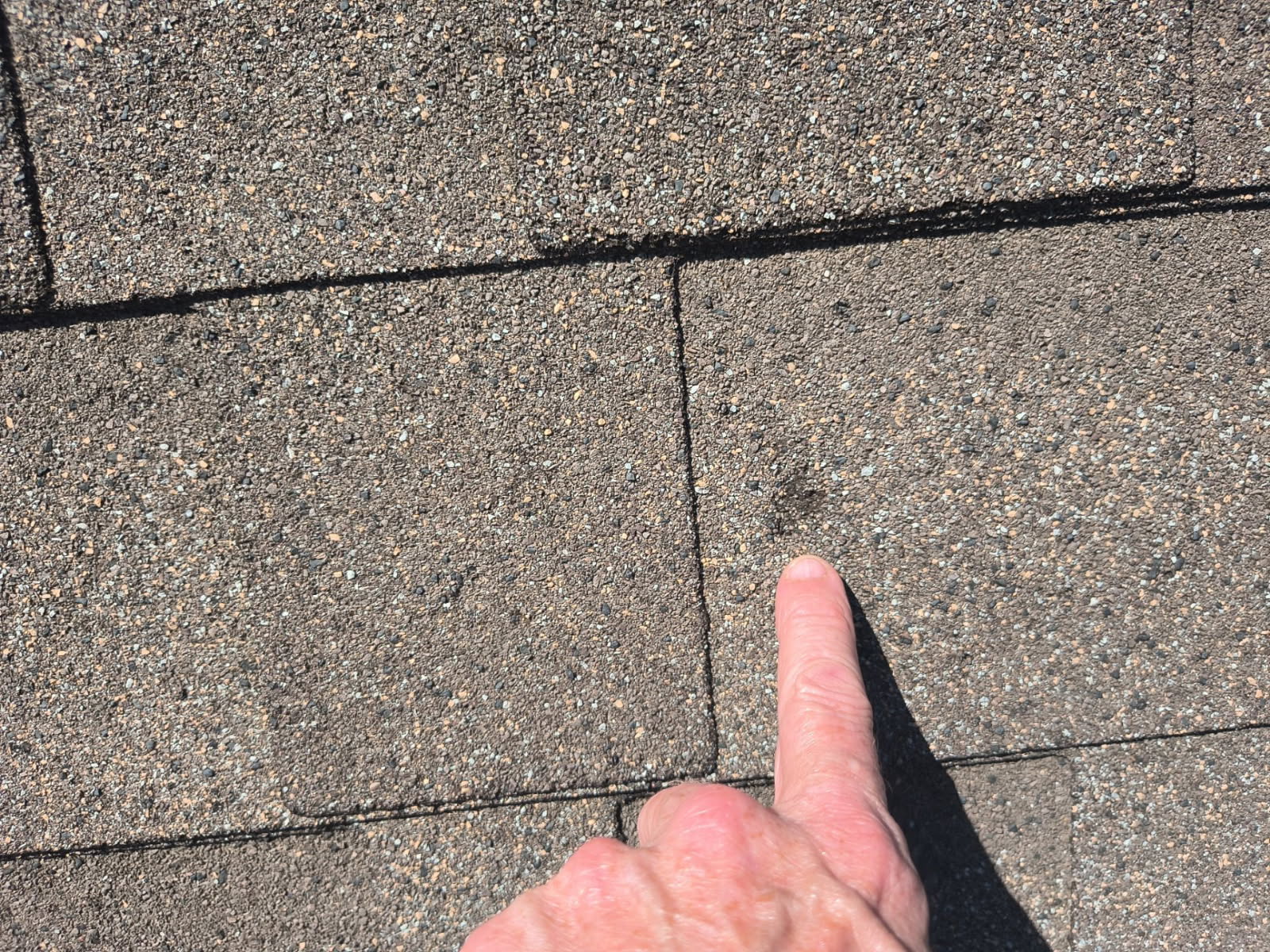
Hail strips the protective granules off the surface of an asphalt shingle. From the ground, you can sometimes see the result as dark bruising, but the more telling sign is granules accumulating in the gutters, splash blocks, and at the bottom of downspouts. A roofer reads the pattern: random scattered loss across the roof points to one impact event; concentrated loss on a specific slope often points to a directional storm. That distinction matters when an adjuster is trying to attribute the damage to a covered weather event versus general wear.

2. Subsurface Bruising
Some of the most expensive damage hail does isn't visible from above the shingle. The impact can fracture the asphalt mat underneath without removing enough granules to look obvious from the ground. A trained inspector finds those bruises by touch — a soft spot under thumb pressure where the mat has separated from its reinforcement. These shorten the shingle's service life by years and rarely show up on a quick photo pass; without them documented, they become someone else's problem in the next storm.
3. Soft Metals — Vents, Gutters, Flashing
Soft-metal evidence is the most reliable witness a hailstorm leaves behind. Aluminum vents, gutter aprons, downspout faces, fascia wraps, and HVAC condenser fins all dent in characteristic ways when hail hits them. A roofer photographs every one of these as part of the inspection because they corroborate the size and direction of the storm. If the soft metals are dented but the shingles look "fine" to the adjuster, that's not the end of the conversation — it's often the beginning of a closer look at the shingles.
4. Underlayment and Decking Damage
Bigger hail can drive water past the shingle layer entirely, soaking underlayment and, in older homes, the decking beneath. We see this most often on pre-1970s Oak Cliff and East Dallas plank decking, where gaps between boards give water somewhere to go. The signs are subtle from the attic side — staining, soft spots, or daylight where there shouldn't be any. Catching this in the inspection means it's included in the claim; catching it six months later, after a leak, often means it isn't.
What Should You Do in the First Day or Two After a Dallas Hailstorm?
Five practical steps. The order matters, and a couple of them are about what not to do.
1. Stay Off the Roof
A roof that just took hail is a slip hazard. Loose granules act like ball bearings under a shoe, and the structural integrity of cracked decking isn't visible from the top. The inspection is what we're trained for; the safety equipment we use exists for a reason. If anything looks urgent — interior water staining, visible holes, debris through a vent — call us and stay inside.
2. Photograph From the Ground
Walk the perimeter and photograph anything visibly damaged from the ground: dented gutters, dented HVAC fins, siding, broken tree limbs, and hailstones in the grass before they melt. These help establish the size and direction of the storm and are useful evidence before a roofer climbs up. If you have a Ring or doorbell camera, save the storm video too — visible hailstones bouncing off the driveway are one of the cleanest data points an inspector can have.
3. Call a Certified Roofer for an Inspection
Look for HAAG-certified inspectors and manufacturer credentials like GAF Master Elite or CertainTeed Select ShingleMaster. Texas does not issue a state-level roofing license, so certifications carry the weight that licensing carries elsewhere. Our inspection includes ground and rooftop photos, soft-metal documentation, attic checks where possible, and a written report you can hold next to the eventual adjuster's. There is no charge.
4. Stabilize Before the Next Significant Rainfall
If the inspection finds anything actively letting water in — a missing shingle section, a punctured pipe boot, a hole through a vent — get it stabilized before the next significant rainfall. Tarping and sealing are temporary, but they keep a repair-scope problem from becoming a replacement-scope problem. Our 24/7 emergency response team handles this same-day in most cases, and the stabilization work is documented on your invoice and report.
5. Keep Your Inspection Report Handy
Keep your written inspection report, photos, and soft-metal documentation together. It's your record of the roof's condition, and you can share it with anyone you choose.
What About the Insurance Side of the Conversation?
Filing the claim is still your call, and there are good reasons to weigh it carefully — your deductible, premium history, the size of the damage relative to the deductible, and where you are in your policy cycle all factor in. We've written separately about how ACV, RCV, depreciation, and deductibles work in a roofing claim, and about why Texas homeowners' premiums and deductibles have climbed. Both are worth reading before the conversation with your carrier. If the storm also hit a commercial property, our companion guide on commercial hail damage insurance claims in Dallas covers the differences in scope, scale, and adjuster expectations on that side. The broader point: documenting the damage is the homeowner's job to initiate, and a certified roofer is the part of that job most people don't have to do alone.
Frequently Asked Questions About Calling a Roofer After Hail Damage in Dallas
Will my insurance company penalize me for getting a roof inspection before I file a claim?
No. An independent inspection before filing is not a claim-trigger by itself and doesn't appear on a claim history report. Many homeowners call a roofer, find out the damage is minor enough to handle out of pocket, and never file at all — the inspection-first approach sometimes saves a claim from being filed unnecessarily.
How long after a hailstorm do I have to file a claim in Texas?
Texas insurance code generally allows one year from the date of loss to file a claim, but most policies have shorter notice requirements — sometimes 30 to 60 days. The longer the gap between storm and inspection, the harder it gets to attribute damage to a specific event. We recommend an inspection within a couple of weeks of any storm that left quarter-sized or larger hailstones on the ground.
What does HAAG-certified mean, and why does it matter?
HAAG Engineering certifies inspectors specifically in damage assessment for roofs and exterior building components. The certification requires testing in identifying impact damage versus mechanical damage versus weathering — exactly the distinctions that come up in a hail claim. In a state like Texas where there is no roofing license, HAAG certification is one of the strongest credentials an inspector can carry.
The adjuster said the damage is cosmetic. Should I get a second opinion?
Often, yes. "Cosmetic" is a real category — a few isolated dings on a metal panel that don't affect performance can fairly be classified that way. But the same word sometimes gets applied to hail bruising on asphalt shingles that has fractured the mat. A second inspection by a HAAG-certified roofer can give you an independent view of your roof's condition. Questions about your claim itself should go to your insurance company or agent.
Will a roof inspection cost me anything?
Not from us. Inspections are free, written, and yours to keep — whether you eventually file a claim, decide to replace the roof out of pocket, or find the storm did less damage than you feared. No obligation, no pressure to schedule work you don't need.
Arrington Roofing has been serving Dallas homeowners since 1983, and post-hail inspections are something we do several times a week during hail season. If a recent storm has you wondering whether your roof took a hit, request a free inspection or call (214) 698-8443. We'll walk the roof, document what we find in writing, and explain — without pressure — what we'd recommend next. You can read more about our Dallas roots and the team behind the work, or browse the rest of our storm damage repair resources.