How to Spot Wind Damage on Your Dallas Roof Before It Becomes a Bigger Problem
Most wind damage to a Dallas roof doesn't announce itself. There's no missing section, no debris in the yard, nothing that looks alarming from the driveway. What actually happens is quieter: a row of shingle tabs lifts just enough to break the seal, a flashing pulls away a quarter inch at a chimney base, a ridge cap cracks and resets in the heat. Everything looks fine for two or three weeks — until a rain event drives water into the gap, and you're looking at a ceiling stain and a call to a roofer. By then, what was a $400 repair in the days after the storm has become a larger job. This post walks through where wind damage actually hides on a Dallas residential roof, why it gets missed so often, and what to do in the first 24 hours after a significant wind event. If you already suspect damage, schedule a free inspection or call (214) 698-8443 — we'll assess the full system and tell you exactly what we find.
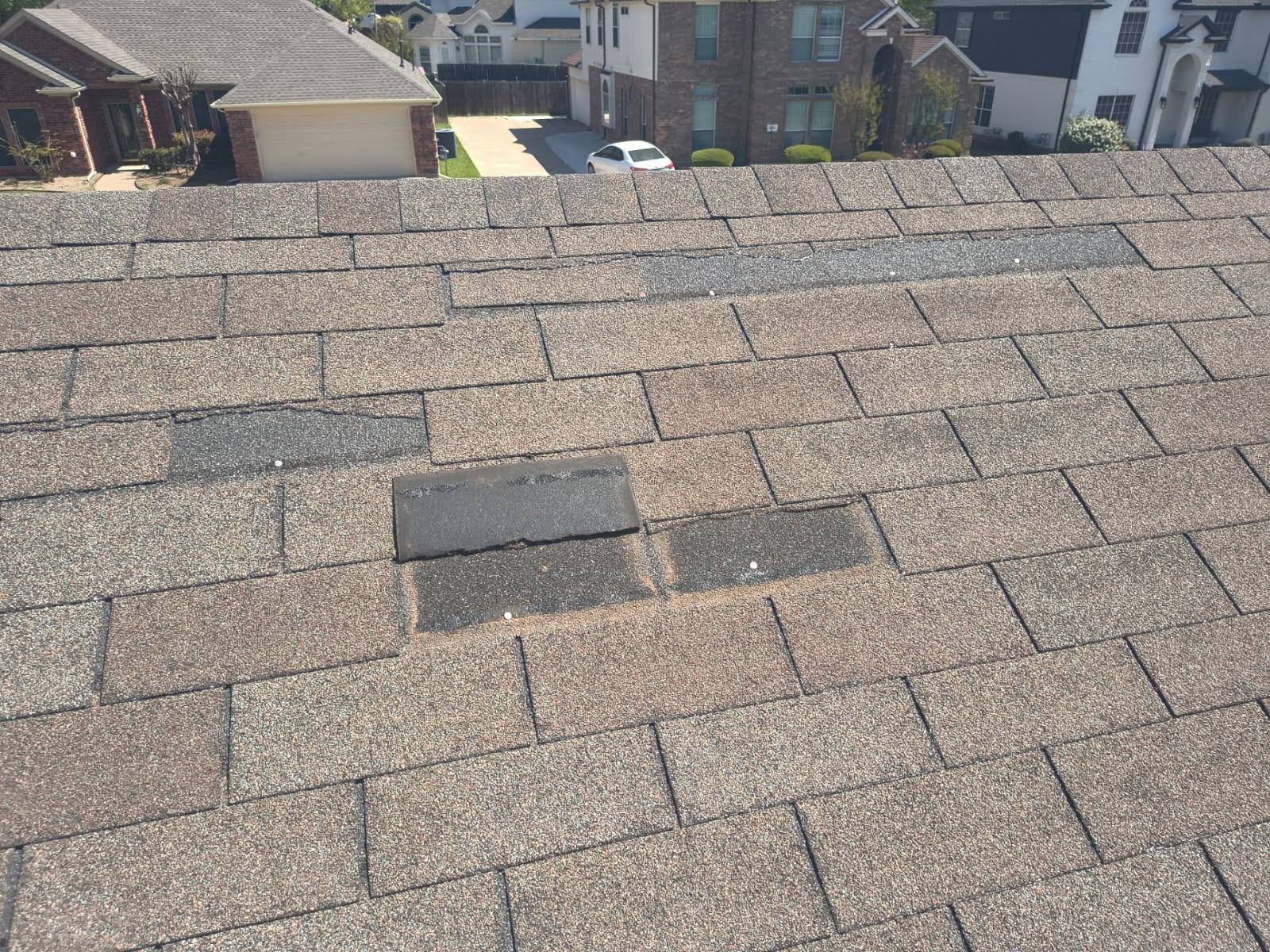
What Does Wind Actually Do to a Dallas Roof?
Understanding where to look starts with understanding what wind stresses. DFW gets three distinct wind threats: severe thunderstorm outflow and derechos (straight-line winds that regularly reach 60–70 mph in West Dallas, Oak Cliff, Grand Prairie, and Irving during spring and early summer), rotating winds from embedded tornadoes or near-miss circulation, and sustained northwest wind behind cold fronts in winter that stresses older sealant and exposed flashing over hours rather than seconds.
Each type produces different failure patterns. Straight-line winds attack the leeward slope — the side of the roof facing away from the wind direction — with uplift force that lifts shingle tabs at their unsealed edges. Rotating wind distributes the stress unpredictably: you may find damage on one corner of the roof and nothing on the adjacent slope. Sustained cold-front winds don't tear anything off but dry and crack aged sealant around penetrations, which then fails silently when the next rain arrives.
The result is that wind damage on a Dallas roof rarely looks like storm damage in the way most homeowners picture it. It's more likely to be a handful of lifted tabs on the back slope, a flashing gap at the chimney base, or a ridge cap that shifted half an inch and no longer sheds water toward the gutter. None of it is visible from the front of the house. All of it matters.
Five Types of Wind Damage to Look For on a Dallas Roof
1. Lifted or Missing Shingle Tabs
The most common wind damage on Dallas asphalt shingle roofs. Wind gets under the lower edge of a shingle tab and lifts it away from the self-sealing adhesive strip. In mild cases the tab reseals when temperatures rise — but the adhesive bond is weakened, and the tab will lift again in the next storm at lower wind speeds. In more significant cases the tab creases or tears at the nail line, and any rain that follows drives beneath it and into the underlayment. These failures are most common in three places: the leeward slope (especially at the rake edges), the ridge line where uplift forces concentrate, and anywhere the shingle course was installed without adequate fasteners. They're almost never visible from the ground — the tab lies flat and looks intact. The only reliable way to confirm them is a close-up inspection of each slope.
2. Ridge Cap Displacement or Cracking
Ridge caps take more wind load than any other part of the roof. They sit at the highest point with exposure on both sides, and they're typically thicker, hand-nailed cap shingles that depend on both fasteners and sealant to stay in place. When wind lifts or cracks them, the ridge — which is the primary water-shedding joint on the entire roof — becomes an entry point. Ridge cap damage shows up as caps that are shifted out of alignment, cracked across the hinge, or missing entirely. On a two-story Dallas home, you'd need binoculars or a drone to see it clearly from the yard. It's commonly missed in post-storm drive-by assessments and commonly found in professional inspections.
3. Flashing Separations at Penetrations and Walls
Flashing — the metal detail work around chimneys, skylights, pipe boots, dormers, and wall-to-roof transitions — is mechanically fastened and sealed, but those seals age and become brittle over time. High wind stresses every fastened junction on the roof, and older sealant cracks under that stress even if the flashing itself doesn't visibly move. The failure is often a gap of a few millimeters at the base of a chimney or around a skylight curb — invisible from the ground, completely effective at directing water into the decking with every subsequent rainfall. Homes in Oak Cliff, Kessler Park, and other older Dallas neighborhoods with multi-piece brick chimneys or decorative dormers are particularly exposed because there are more flashing junctions and the existing sealant is often original to the roof.
4. Edge Metal and Drip Edge Failures
Drip edge and edge metal run along every eave and rake on the roof, directing water off the decking and into the gutter. It's attached with roofing nails and relies on overlap to stay sealed. High straight-line wind — the kind that comes with a derecho or severe thunderstorm outflow — can lift sections of edge metal away from the fascia, bend them out of plane, or pull them entirely free at corners. Once the edge metal is lifted, water from any subsequent rain runs behind the fascia rather than into the gutter, which leads to fascia rot, soffit damage, and eventually interior moisture. It's also a detail that installers sometimes skip or underfasten on budget jobs, which means it can fail at wind speeds well below the storm threshold.
5. Granule Loss and Surface Abrasion
Less a structural failure than an aging accelerant — but worth understanding because it changes the repair calculus. High-velocity wind-driven debris (hail excluded) abrades the granule surface of asphalt shingles, particularly on exposed south and west slopes. Granule loss shows up in gutters after a storm and, over time, accelerates UV degradation of the asphalt layer underneath. On a roof with a few years of service life remaining, a significant wind-abrasion event may push the timeline for replacement forward by two to three years. It's not an emergency repair, but it's worth documenting as part of the inspection record for any future insurance or warranty conversation.
Why Wind Damage Gets Missed So Often in Dallas
Three things conspire to make wind damage the most underreported roof problem in North Texas.
First, the geometry. A typical Dallas residential roof has two to four slopes. The damage almost always concentrates on the leeward slope and the ridge — the parts farthest from street view. A homeowner standing in the front yard after a storm is looking at the windward face, which took the least abuse. The back slope, which took the most, requires a ladder or a drone to inspect properly.
Second, the heat. Dallas summer temperatures cause asphalt shingles to soften enough that lifted tabs often re-adhere during the day. By the time a homeowner gets up to look, the tabs are flat and the sealant looks intact. The bond is weakened — the tab will lift again at lower wind speeds — but there's nothing to see. This is one of the most common reasons wind damage goes undocumented: the roof looks fine the day after the storm.
Third, the timeline. Wind damage that enters water slowly — a hairline crack in flashing sealant, a slightly lifted tab — may not produce a visible interior stain until the second or third significant rainfall after the event. By then the homeowner doesn't connect the stain to the storm three weeks ago, and the claim window gets complicated. Documenting damage promptly after a wind event, even when nothing is obviously wrong, protects that timeline.
What to Do in the First 24 Hours After a Dallas Wind Event
The most useful thing you can do immediately after a significant storm is document from the ground before anything is disturbed. Walk the perimeter of the house and photograph anything visible — shifted ridge caps, missing shingles, debris on the roof, granules in the gutters, any interior ceiling stains that appear in the hours after the storm. That photographic record with a timestamp is the foundation of any insurance documentation that follows.
Then call a roofer before you call your insurance carrier. The same logic that applies after hail applies here: an adjuster arriving at a property without an independent inspection documents what they see, not necessarily what's there. An Arrington inspection gives your adjuster a complete, documented scope of what the wind event actually did — lifted tabs on the back slope, flashing separations, edge metal failures — before the claim is filed. Our post on why your first call after storm damage should be a roofer, not your insurance adjuster covers the full reasoning, and it applies to wind events exactly as it does to hail.
If any section of the roof is confirmed open — a missing shingle section, lifted edge metal, a separated flashing — we tarp and stabilize the exposure the same day so the damage doesn't grow before the repair is scheduled. A wind damage roof repair handled promptly is almost always a localized fix. Left through one or two rain events, it becomes a decking and insulation problem. And if a wind event also produced hail — which is common in DFW spring storms — we assess both in the same inspection. The hail damage repair process runs alongside the wind assessment so you get one scope, one documentation packet, and one claim file.
After the repair, our roof repair hub covers the full range of what we handle in Dallas — storm damage, emergency repairs, and everything in between. If you're in Arlington or Irving, both of which sit in the path of the most active straight-line wind corridors in the metro, the same inspection and documentation process applies. Our GAF Master Elite certification means every repair is documented to manufacturer spec — which matters for both warranty integrity and insurance claim support.
Frequently Asked Questions About Wind Damage on Dallas Roofs
How do I know if my roof has wind damage if I can't see anything from the ground?
The honest answer is that you usually can't confirm wind damage from the ground — the failure points that matter most (lifted tabs on the back slope, flashing separations, ridge cap cracks) aren't visible without getting onto or above the roof. Granules in the gutters after a storm are one ground-level signal worth noting. Interior ceiling stains that appear in the days after a wind event are another. But the only reliable confirmation is a close-up inspection of each slope. Arrington's inspections are free and come with a written assessment — there's no cost to knowing what's actually there.
Does Texas homeowner's insurance cover wind damage to roofs?
In most cases, yes. Texas homeowner's policies cover wind as a standard covered peril — sudden damage from a named storm event, a derecho, or a severe thunderstorm is typically covered subject to your deductible. What's excluded is damage caused by wear, age, or deferred maintenance rather than the storm itself. The documentation we provide — timestamped photographs, a written scope of failure points, assessment of pre-existing vs. storm-caused damage — gives your adjuster a clear picture of what's covered and why.
What's the difference between wind damage and storm damage on a roof?
In insurance and roofing terms, they're both typically filed under the same claim type — sudden weather-related damage — but they cause different failure patterns. Wind damage is primarily mechanical: uplift, separation, displacement. Storm damage often combines wind with water intrusion, fallen debris, or hail impact. The distinction matters for repair scope: wind damage is usually repairable at specific failure points, while storm damage sometimes involves broader water infiltration into decking and insulation that requires a larger scope. An inspection determines which situation you're in.
How long after a wind storm do I have to file a roof insurance claim in Texas?
Texas law requires insurers to accept claims within one year of the date of loss for most residential policies, though some policies have shorter windows written into them. The practical advice is to document and file promptly — not because the legal window is tight, but because the earlier an inspection happens, the cleaner the documentation is. A roof that sat through two more rainstorms before inspection has a more complicated damage picture than one inspected the week after the wind event.
Can a partial shingle repair after wind damage void my roof warranty?
Not when the repair is done by a certified contractor using manufacturer-approved materials and methods. What voids warranties is unapproved materials, improper fastener patterns, or repairs that deviate from the manufacturer's installation spec. Arrington is GAF Master Elite certified, which means every repair — including partial shingle replacement after wind damage — is documented to the standard required to keep your warranty intact.
If you experienced a wind event recently and want to know what actually happened to your roof, call (214) 698-8443 or request a free inspection online. We'll walk every slope, document what we find, and give you a written assessment before recommending any work.